How To Know If You Have Hard Water: 6 Signs to Check Today
Cloudy glassware, crusty faucets, and soap that will not lather. Here are the six signs of hard water, how to…


If you’re on municipal water in Vancouver, Camas, or Portland, you have probably wondered whether a whole-house filter is worth it. It’s a fair question, but the honest answer is not a simple yes or no. City water already comes with oversight from federal and state regulators. Whether filtration makes sense for your home comes down to a few specific questions, not fear about what might be in your tap.
Public water utilities treat their water and are regulated under the Safe Drinking Water Act. The EPA sets enforceable limits on the disinfectants utilities use, chlorine and chloramine included, and on the byproducts those chemicals create. Public water systems are required to meet federal and state drinking water standards and to conduct regular monitoring. In Washington and Oregon, state drinking water programs oversee that work, and utilities must notify customers if a standard is violated. In short, your water utility is doing real, monitored work to meet those standards.
For many households on city water, the more practical question is whether you want to reduce disinfectant taste and smell, ease the chlorine feel on skin and hair, or address something specific your water quality report flagged. Those are often comfort and preference decisions, not emergencies. We treat them that way in every filtration conversation we have.
This is the detail most filtration conversations skip, and it changes everything about what system you need. Utilities disinfect with either chlorine or chloramine, a longer-lasting combination of chlorine and ammonia. More than one in five Americans are on chloraminated water today.
Standard activated carbon handles free chlorine well, but chloramine is a different story. Chloramine is more stable than chlorine, so reducing it can require a different filtration media, such as catalytic carbon, along with enough contact time as water passes through the system. That means a filter needs to be designed and sized with chloramine in mind, not just chlorine. If your filter wasn’t built with this in mind, it may not be doing what you think it is.
This is why we don’t sell one generic “city water filter.” Instead, we match the media to what your utility actually uses. The City of Camas and the City of Vancouver’s utility both report disinfecting with chlorine, not chloramine. But Clark County has more than one water provider, and treatment can vary by neighborhood. Checking your specific utility’s published water quality report is the honest starting point, not a guess.

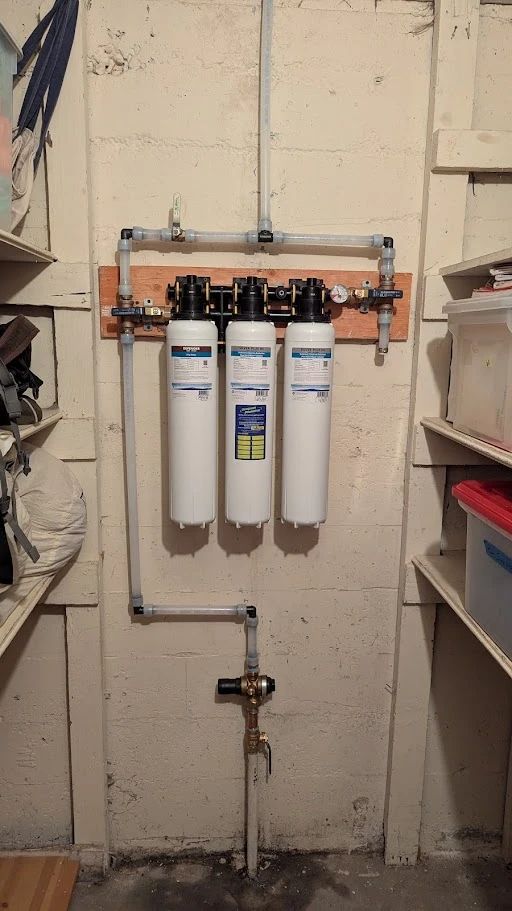
A whole-home water filtration system installs at your main water line and treats every tap in the house, not just the kitchen sink. For municipal water, this usually means a sediment pre-filter paired with a carbon stage sized to reduce chlorine or chloramine taste and odor, plus anything else your water report flags.
It reduces disinfectant taste, odor, and many disinfection byproducts. It is a different tool than a water softener, which addresses mineral hardness, and different again from reverse osmosis, which targets a narrower range of contaminants at a single tap. Some homes benefit from combining approaches. Many do fine with just one.
If you’re on a private well instead, this whole conversation changes. Well water isn’t federally regulated the way city water is, and the concerns (iron, bacteria, hardness) usually differ from a municipal supply. A system built for city water is not the right fit for a well, and vice versa. If you’re not sure which applies to you, that’s one of the first things we sort out.
A few honest questions help more than any sales pitch:
None of these have a wrong answer. They just point toward different solutions, sometimes toward no system at all.
Before recommending anything, we start with a Free Home Water Review, because it helps to know your water before deciding what to do about it. For city water customers, that starts with your utility’s published water quality report for your ZIP code, which tells us whether your water is treated with chlorine or chloramine and what your utility has reported. We also talk through what’s bothering you, whether that’s a chlorine taste or something your report flagged, and look at your home’s plumbing in person. From there, we can tell you whether filtration makes sense for your home and, if it does, what kind.
This is an educational review, not an automatic lab or contaminant test. If a specific contaminant is on your mind, we can talk about whether targeted testing would be worthwhile. You’ll leave with a clearer picture of your water and your options, and there’s no obligation to buy anything.
Simpson Plumbing & Filtration has served Vancouver WA, Camas, and Portland OR since 1981. That history means we’ve seen how local water conditions actually behave, not just what a spec sheet claims.
Not necessarily. City water is held to federal and state drinking water standards, and your utility monitors it on a regular schedule. For many households, filtration is about taste, odor, and comfort on top of that baseline, not a requirement.
It depends on whether your utility uses chlorine or chloramine. Standard carbon handles chlorine well, but chloramine can require a different media, such as catalytic carbon, and enough contact time to be reduced effectively. Check your water quality report first.
Many homeowners filter city water for taste and odor rather than a health concern, and that’s a reasonable choice. For many homes on regulated city water, it’s a preference decision rather than a requirement.
Costs vary by home size, water conditions, and system type, generally from around a thousand dollars for a basic setup to several thousand for a more complete system. We give specific pricing after a home evaluation, not a generic number.
Ongoing filter replacement and periodic maintenance are the main ones. An oversized or mismatched system can also underperform, which is why matching the system to your actual water matters more than buying the biggest option.
It depends on your specific utility, and Clark County has more than one provider. Your utility’s water quality report states this directly, and we can look it up with you as part of a Free Home Water Review.
City water in the Northwest is regulated, treated, and regularly monitored. Whether filtration belongs in your home comes down to what disinfectant your utility uses, what your water report shows, and how much the taste and feel of your water bothers you day to day. If you want a straight answer instead of a sales pitch, request a Free Home Water Review, and we’ll help you understand your water and your options.